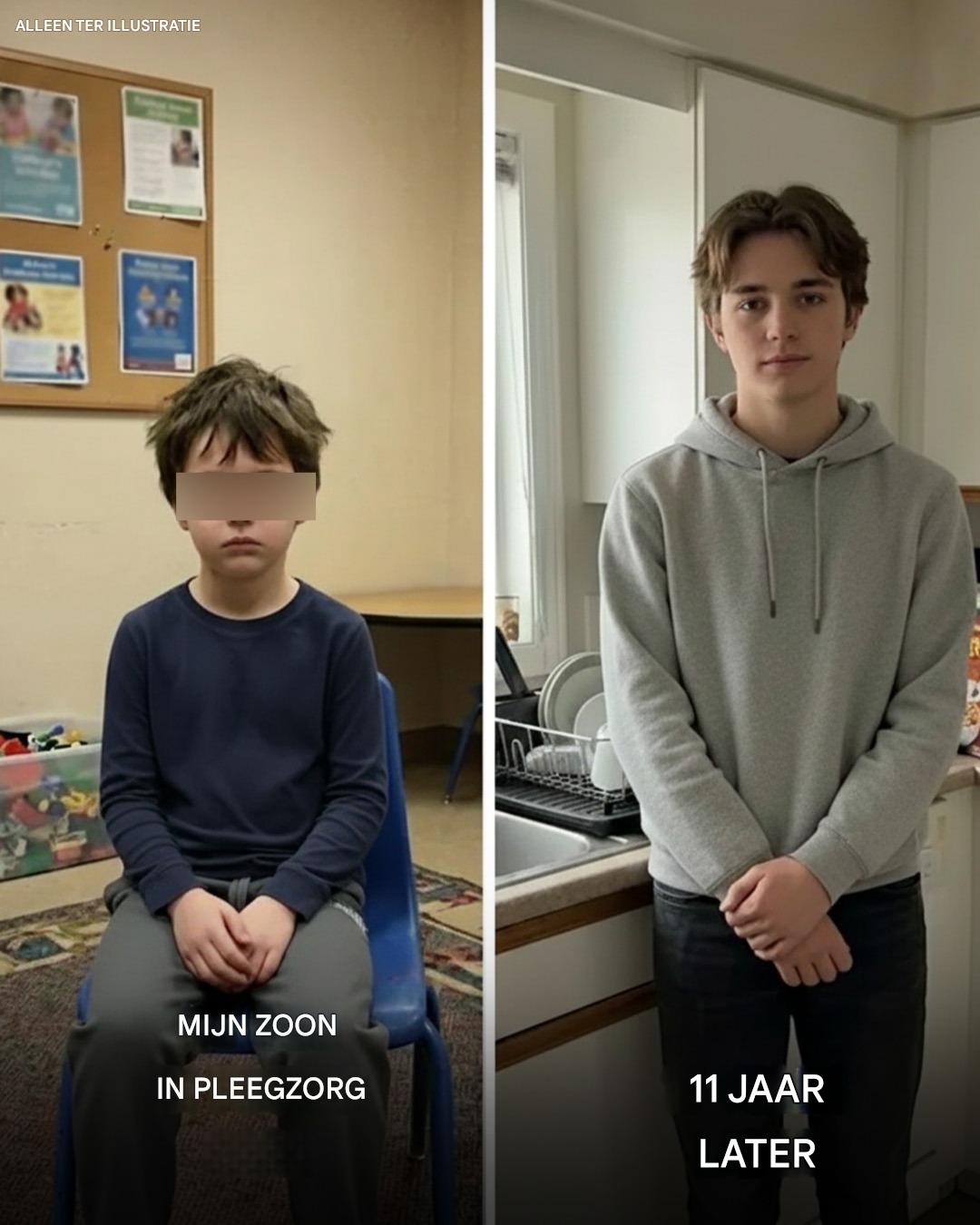
Even as a little boy, he never reached for anything quickly. If I brought him new sneakers, he'd hold the box and ask, "Are you sure these are really mine?"
Mike had learned too early that good things could disappear without warning. I met him when he was seven years old.
Mike had a way of accepting love as though it came with an expiration date.
I'd spent years trying to build the family I thought I would have. My marriage cracked in the ugliest way, and the man I thought I knew walked out as if none of it had ever mattered.
I still wanted to be a mother, and once I realized no one was coming along to build that life with me, I decided I would build it myself.
That was when I heard about Mike.
The social worker hesitated when she said his name. She told me he'd been in the system for over three years, that he was older than most families wanted.
I'd spent years trying to build the family I thought I would have.
When I asked why no one had taken Mike, she said, "You've probably heard about it. It was in the news."
I told the social worker that I hadn't heard anything.
"Then maybe that's for the best," she replied.
When I met Mike, he looked at me as if he'd already practiced being disappointed.
"Hi," I said.
"Hi," he answered. Then he said, "I know you're not going to take me, so we can make this quick."
That sentence shattered something in me.
He'd already practiced being disappointed.
"Why would you say that, sweetie?" I asked.
Mike shrugged. No seven-year-old should already sound that resigned, and yet that shrug would come back to haunt me in ways I never saw coming.
I signed the papers. After the checks and interviews were done, I brought Mike home with me… and from that day on, he wasn't just a child I adopted. He was my son.
One night, not long after he moved in, I tucked him in and kissed his forehead.
Mike caught my hand before I pulled away, his small fingers tightening slightly. "If I mess something up… I still get to stay, right?"
"You still get to stay, baby. That part isn't changing."
He nodded once and whispered, "Okay."
"If I mess something up… I still get to stay, right?"
And just like that, time moved forward without asking either of us if we were ready.
The morning after his 18th birthday, Mike came into the kitchen quieter than usual.
I slid a plate toward him. "There's still cake if you want breakfast to make no sense!"
He gave me a faint smile, but it didn't last.
"Mom," he said, and something in the way he said it made me set my coffee down.
"I'm an adult now. I'm not afraid anymore." Mike looked straight at me. "I'm finally ready to tell you what really happened back then."
Nothing prepares you for the moment your child hands you the part of himself he's been hiding.
"I'm finally ready to tell you what really happened back then."
"Will you listen?" Mike asked.
My heart raced as I said, "Always, dear."
"For a long time," Mike began, staring at the table, "I thought I was the reason things kept going bad. Whenever something broke, or people argued, or plans fell apart, I'd think it started with me. After a while, it stopped feeling random."
My brows pulled together. "Why would you think that? What are you talking about?"
"Someone told me that wherever I went, bad things followed." Mike looked up, and there was shame on his face that should never have belonged there. "That I was cursed. That people knew it. That's why no one wanted me."
The words landed like stones.
"I was cursed."
"You gave up so much for me, Mom," he added. "You never married again. You built your whole life around me. And if that happened because of me, then maybe it was true all along."
"You are not ruining my life," I said.
"I know you want to say that, Mom. But you had to give up a lot."
I reached across the table, but Mike stood before I could touch his hand.
"I'm going to meet a friend. I just needed to tell you." He paused. "Please don't be upset."
"I'm not upset with you, honey," I told him.
He nodded, but I could see he didn't fully believe me.
"And if that happened because of me, then maybe it was true all along."
When he walked out that door, something in me said, not this, not for my child.
I thought about the little things that made sense now. The way Mike apologized when the power went out during a storm. The way he asked me at 10 years old, when the pipe under the sink started leaking, "Does this mean it's started again?"
And all I could think was… who put that in his head?
I grabbed my keys.
The same social worker met me at the adoption center, older and tired but recognizing me right away.
"I need you to tell me what followed my son here," I demanded.
"Does this mean it's started again?"
"He was taken from a foster placement when he was little," she revealed. "An old woman made claims. It got shared everywhere. People talked about him like he was a warning instead of a boy."
"What claims?"
"That he brought misfortune," she said. "Families were afraid because they'd heard he was 'the cursed boy.'"
Hearing it out loud made me feel sick. And somewhere out there, the woman behind those words was still breathing, while my son had spent years believing them.
"Do you know her name?" I urged.
"Margaret," the social worker replied. Before I left, she said, "I'm glad he had you."
"So am I," I answered, hurrying out.
"Do you know her name?"
I drove to the library, and tucked between years of records, I found an old newspaper article. The headline alone made my face burn.
The second I read the word "cursed" in black print above a photograph of my son as a toddler, I understood that what had followed Mike was bigger than one cruel sentence. It had been handed to the world.
Margaret had claimed the child brought misfortune: a lost pregnancy, trouble in the family business, and later, what happened to the couple who had taken him in.
It was written in that oily, sensational tone small-town outlets use when they want people talking more than thinking. How easy it had been to take an old woman's superstition and turn it into a child's identity.
Margaret had claimed the child brought misfortune.
By the time I had printed the page, my hands were shaking. I had come looking for information. What I found was evidence of failure, and finally, I had an address.
Margaret lived in a narrow house with brittle flowerpots on the porch and curtains pulled too tightly across the windows.
I knocked, and the moment she opened the door, I said Mike's name, and the shift in her expression confirmed everything.
"What do you want?" she asked.
"The truth."
"I already told the truth about that boy years ago," she hissed.
"What do you want?"
"No. You told a story a child ended up living inside," I retorted.
Margaret looked away at first. But after a long pause, she finally revealed the full picture.